If your thoughts won't stop during meditation, let them come. Thoughts are welcome, and they are part of the practice. They arise on their own and they leave on their own, so there is nothing to stop. Watch them with curiosity, the way you would watch a movie, and when you notice you drifted, smile and come back.
 A free guide and videoMeditation Mythbusting, plus a gentle guided practice. Get it free below

Do I have a monkey mind?
In our trainings, the meditation part is the part many people are scared of. 'My mind is too busy.' 'My mind bounces around too much.' And then comes the dreaded phrase, monkey mind.
Daniela's answer: 'It's the worst phrase.' Many of the methods we inherited were built for monastics. As a householder, you have the to-do list, the relationship that is nagging at you, the question of how in the heck you are going to make Monday work. As Daniela puts it, quoting our mentor Lorin Roche, the to-do list comes up because it is 1 of the many ways you show your love for the people you care about.
'It does not mean you have a monkey mind,' she says. 'It means you're engaged in your life with care, love and presence.' Not only do we not have monkey minds, we have brilliant creative minds.
Daniela makes this case in her own words in a short clip in The Door Was Never Locked, the story of how I finally found my way in.
Are thoughts a problem in meditation?
No. Thoughts are welcome, and they are a part of the meditative process. Whatever technique you practice, the technique and the thoughts coexist. Sometimes you will feel some space between the thoughts. That is lovely, and it is not the point of meditation. It is not a requirement for meditation to be effective.
Lorin Roche created a map of what is happening while you sit, called the Eight R's: relax, release, replay, repair, restore, remember, rehearse and rest. Your nervous system moves through that cycle again and again, and for the first 5 to 10 minutes, for basically everybody, almost all your time is spent there. The replaying and the rehearsing are thoughts. When I teach Lorin's map, I say it plainly. 'Thinking is meditating. Thinking is processing. It's totally okay.'
What is the movie screen of the mind?
In the full guided sit in Lesson 5 of our course, after a few minutes with the breath, I invite you to imagine that your mind is like a movie screen, and you don't know what's going to show up. You sit down in the theater. You don't know what the show is, what it's called, who the actors are or what the plot is. The lights go down. The screen lights up. And you watch.
'Some thoughts stay for a little while. Some flicker in and out. It doesn't matter. We're not trying to hold on to any thoughts or push any thoughts away.' You are just being curious, letting them rise and fall.
Afterward, I asked who noticed fewer thoughts than they would have expected, and some said fewer, for sure. The thoughts came unbidden, lived their life and exited. You had nothing to do there.
Daniela adds a piece I love. 'They're little movie clips,' she says of thoughts, and she invites you to become a scientist, a tremendous observer of your mind. Our thoughts are 'not the bad guy,' she says. You didn't do anything to make those particular thoughts show up on the movie screen. They arise on their own. They dissolve on their own.
What if a thought pulls me all the way in?
Think of the attention you give a book you are enjoying while you sit in a busy bus station. You are aware of the people around you, and the book is still your primary focus. A sound pulls you away. You look, and then, oh, back to the book. 'You don't chide yourself for not looking at the book for a moment.' The book is there. It was waiting for you all along.
Meditation is the same. Sometimes your attention is on what you are exploring, and sometimes it is pulled into other thought streams, usually the past or the future. They play out their life, and then, ah, here we go again, back inward. We're not trying to stop the thoughts. We're not trying to pin the attention onto something. We are allowing that interplay. This easy, book-in-the-station attention is the heart of Effortless Meditation.
Your mind also has a natural speed, and in meditation it sometimes speeds up instead of slowing down. That is normal. When I lived in New York City, a group met to meditate in Times Square. They called it the Big Quiet, and they welcomed the chaos around them with the same attention you give a good book in a busy station.
Why is 'wait, where was I?' a golden thought?
Sooner or later it comes. Oh, wait a minute, where was I? I'm supposed to be meditating. I was planning lunch. And we shame ourselves. Bad meditator, bad meditator.
A meditation teacher of mine called this the golden thought, and I want you to celebrate it. That thought only and always happens in the present moment. It is the dawning of awareness, your nervous system recalibrating to the present from all those thoughts of the past and the future. So instead of letting it be evidence you weren't doing it right, let it be evidence that you were. You just finished a cycle. Smile to yourself and say, all right, that's wonderful.
If you practice with a mantra, the golden thought is your cue to drop the sound back in, like a weight on a fishing line. I walk through that in Mantra Meditation for Beginners.
Why do some thoughts come with so much feeling?
Daniela teaches a model that separates the thought from the emotion. During the movie screen practice in our workshop, she watched a blank screen, and then the face of a dear friend appeared with her big smile. Daniela believed that thought true, thought, I love her, and the sensations of warmth filled her.
It is instantaneous, she says, 'boom, boom, boom, boom, 4 things.' A thought you lean into and believe true creates a corresponding emotion. The emotion creates felt sensations in your body. The sensations create a corresponding vibration that emits out of you. Thoughts you do not engage with simply move on.
So of the 80,000 thoughts we have on a good day, how many are you aware of? 'Awareness is your greatest power,' Daniela says.
What do I do with the thoughts I don't like?
Sometimes, when you sit, a rush comes through. Emotions, memories, worries or anxiety for the future. So imagine you are throwing a Halloween party, and 200 people show up, much to your surprise, all wearing different costumes. You know the kind of costumes people wear on Halloween. They can be a little wild.
Greed, regret, envy, all of these so-called negative emotions have equal play in our life with the ones we prefer. Someone who comes dressed as a devil is not a bad person. Meditation is a chance to suspend judgment, welcome everybody in all of their costumes, and imagine there is something here for you to learn, to heal, to integrate, or perhaps a boundary to set. The next day, the party is over and everybody has gone home, and you have free will as a sovereign being about what you engage with.
It can feel messy. Meditation is a little like doing the dishes after a dinner party. We wouldn't expect the kitchen to be clean while we are cleaning it. It is clean later, and over days or weeks, the mind starts to become a little calmer.
How do I practice with a busy mind today?
Try this for 60 seconds. Eyes open or closed, it doesn't matter. Be an observer, and be curious about what shows up.
Afterward, run through a short checklist from our course. Did I welcome my thoughts and my feelings? Did I allow what arises to be here, and did I allow it to fade away? Did I welcome my natural speed, whether it felt sleepy or racy? All of this is equally okay.
If you would like these skills in order, with Daniela and me guiding you, the Effortless Meditation Course walks you through them, with a 7-day money-back guarantee. Or begin with our free guide, Meditation Mythbusting, where myth number 1 is the belief that meditation means stopping all thoughts.
So the next time your thoughts won't stop, let the lights go down and watch the screen. How little can you do? How much can you allow?
Common questions about a busy mind
Is it normal to have lots of thoughts during meditation?
Yes. Thoughts are welcome and they are part of the meditative process. Daniela Hess notes we have around 80,000 thoughts on a good day, and for the first 5 to 10 minutes of a sit, almost everyone spends most of the time thinking. Thinking is processing.
How do I stop my thoughts when I meditate?
You do not need to. Thoughts arise on their own and leave on their own. Christopher Grant suggests watching them like scenes on the movie screen of your mind, with curiosity, without pulling in the scenes you like or pushing away the ones you do not.
What is the golden thought in meditation?
It is the moment you realize, wait, where was I? I'm supposed to be meditating. Instead of treating it as proof you failed, treat it as proof you were meditating. It always happens in the present moment and marks the dawning of awareness after a natural cycle.
What should I do with difficult thoughts or emotions while meditating?
Welcome them like guests at a Halloween party. A guest dressed as a devil is not a bad person. Give everything that arises a little space during the sit, without judging it. Afterward, you are free to choose what you engage with.
Do I have a monkey mind?
No. Daniela Hess calls monkey mind the worst phrase. A busy mind in meditation means you are engaged in your life with care, love and presence. As Lorin Roche teaches, the to-do list shows up because it is 1 of the ways you show love.
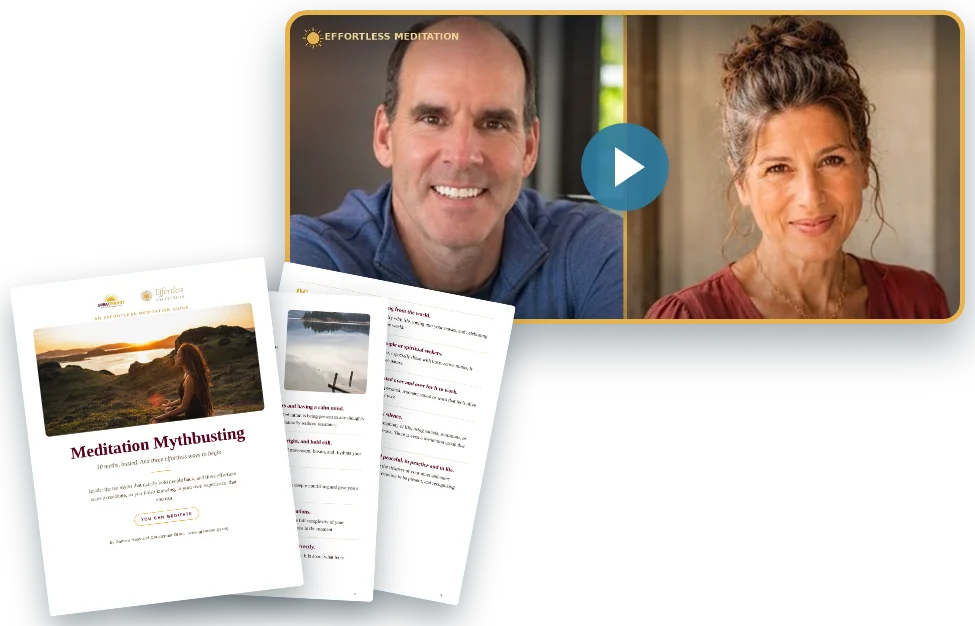
You can meditate. Start with the free guide and video.
- Meditation Mythbusting: 10 common myths, busted (PDF)
- Your First Effortless Meditation, a gentle guided practice (video)
Sources: Christopher Grant and Daniela Hess in the Effortless Meditation Course, Lessons 1, 2, 3 and 5 (the book in a busy station, the movie screen, the Halloween party, the golden thought), the Eight R's office hours (Lorin Roche's Eight R's), the December 15, 2024 You Can Meditate workshop, and the Meditation Mythbusting handout.
More than a guided course. A living practice you carry into everyday life. See the Effortless Meditation Course, or browse the other articles.