The Effortless Meditation Course You do not have a monkey mind.
You have a full mind, living a full life. In 5 lessons, Daniela and I show you how to let that mind settle on its own, the way sleep arrives, so a few quiet minutes become something you look forward to. It starts with 1 shift, and it is the opposite of what you were taught.
why we bring you practices that fit the rhythms of a full life, with pets, taxes, family and colleagues
who we are, after 30 years as educators, practitioners and forever students
the 1 test we use for any practice, and it starts when you open your eyes
how we teach, so you can feel whether it fits you before you enroll
Lesson 1 opens the moment your payment is confirmed. 7-day money-back guarantee.
Who this is for
If you have ever said 'I'm just not a meditator'
You tried an app or a class, and stopped.
You sit down, and your mind fills with the day's list.
You know you 'should' meditate, and you do not enjoy it.
You have a job, a family and a full calendar, and 30 silent minutes is not going to happen.
5 myths from our free Meditation Myth-Busting guide, and what we teach instead
The myth
What we teach instead
Meditation means stopping all thoughts.
You do not have a monkey mind. You let thoughts and emotions flow without resistance.
You have to sit cross-legged, upright and still.
Any position that feels nourishing and supported works, including lying down.
You must meditate for hours to benefit.
A few minutes, several times a day, is the practice.
A specific mantra must be repeated over and over.
A mantra is optional, and it should feel alive to you.
Meditation only works in total silence.
Sounds and sensations around you can be part of the sit.
Most of us were handed 1 instruction: sit still and clear your mind. When the thoughts kept coming, we felt like we were failing at something simple, and we quit.
The instruction was the problem. Nobody should give up on meditation because of 1 bad instruction. You cannot make yourself go to sleep. You allow sleep to overtake you. Meditation is like that.
Left alone, the old instruction keeps winning. You try again in January, the thoughts come, you file yourself under 'not a meditator' for another year, and the day's list keeps setting the pace.
No silent hour. No perfect posture. No empty mind required.
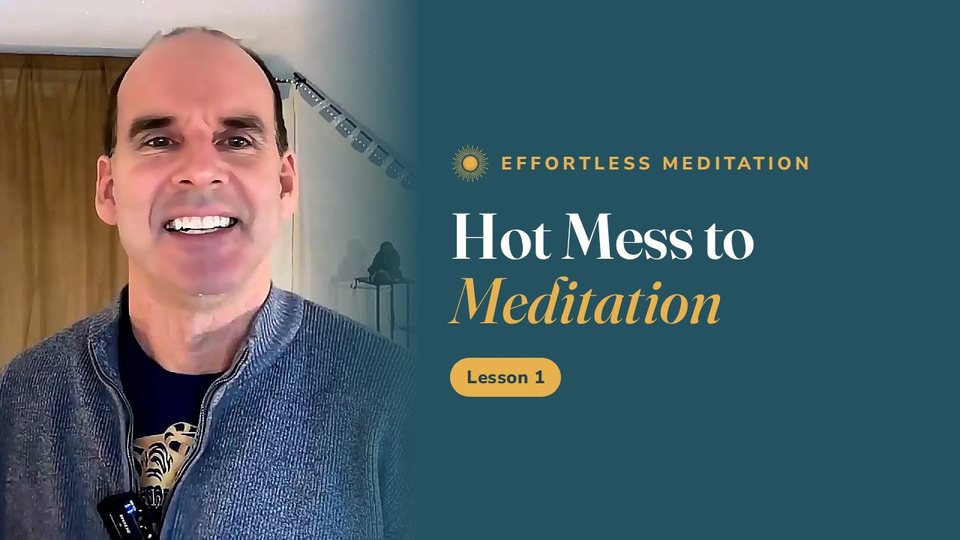
Watch me tell it, from the first minutes of Lesson 1.
Before I learned to meditate, I was a hot mess disaster, mentally. Anxiety, depression and addiction dominated my life, and I tried and tried to find a way out.
In my early 20s I went to my first Zen meditation. I could barely sit still. More than 30 years later, I still remember the rush of energy as the chaos came down just a little bit, from fifth gear to about four and a half. I felt so good that I left the meditation and went and did something silly. That little bit of clearing stayed with me. Even so, it was not the only room I walked out of in those early years. They all ended the same way, with me deciding this was not for me.
My teacher, Sri Sri Ravi Shankar, later guided me into Sahaj Samadhi meditation, and I sat silent Vipassana retreats in the tradition of S.N. Goenka. What I came to discover is that meditation does not take any effort at all. I would have saved myself a decade if someone had put it to me that way at the start. You let go of holding on to the shore of the river, and you let the river carry you, the way it carries you into sleep.
Today a few minutes is enough. Meditation can feel like a micro-nap, a few minutes where you step back from it all and take a break. So Daniela and I call our approach Effortless Meditation. We did not make it up. Sahaj means effortless.
The method
What is Effortless Meditation?
Effortless Meditation is a gentle way of meditating where you let the mind settle on its own instead of forcing it to go quiet. You come in through the body, through the breath and the senses. You learn a few small skills. And you practice for a few minutes, several times a day, right inside a full and busy life.
By the end of Lesson 3 you have 2 tools you can use anywhere: SSFB, a 1-minute way to arrive in the body, and So Hum, a mantra sit for the moments your mind is full.
A practice that fits your lifeShort skills for people with jobs, family and full calendars, not a monk on a mountain.
Ease with a busy mindStop fighting your thoughts. Let them come and go while you settle underneath.
Calm you can return toA few quiet minutes, practiced often, become a place you can return to.
Instead of forcing your mind quiet, Effortless Meditation lets it settle on its own, the way sleep arrives. Your thoughts can stay. That 1 shift is the whole course.
Watch before you enroll
Watch 3 short clips from the course
Real moments from the lessons, as they are in the course. Press play on any one.
Lesson 1 opens the moment your payment is confirmed. 7-day money-back guarantee.
How it works
3 steps, at your own pace
Enroll$47, 1 payment. Lesson 1 opens the moment your payment is confirmed.
Learn the skillsWatch the 5 lessons at your own pace, in pieces if you like. Print the cards.
Practice in small dosesA few minutes, a few times a day, at your desk, in a parked car or before bed. The lessons are yours for life.
Picture an ordinary Tuesday
You sit for 4 minutes before your first meeting. The thoughts still come, and you let them pass without a fight. You stand up a little slower and a little kinder. And you stop calling yourself 'not a meditator'. You are someone who meditates, inside the life you already have.
What is inside
What you learn: 5 lessons and 4 bonus practices
The main track · about 3 hours 14 minutes
01Effortless Meditation 101. What it is, and why it is effortless. 28 min
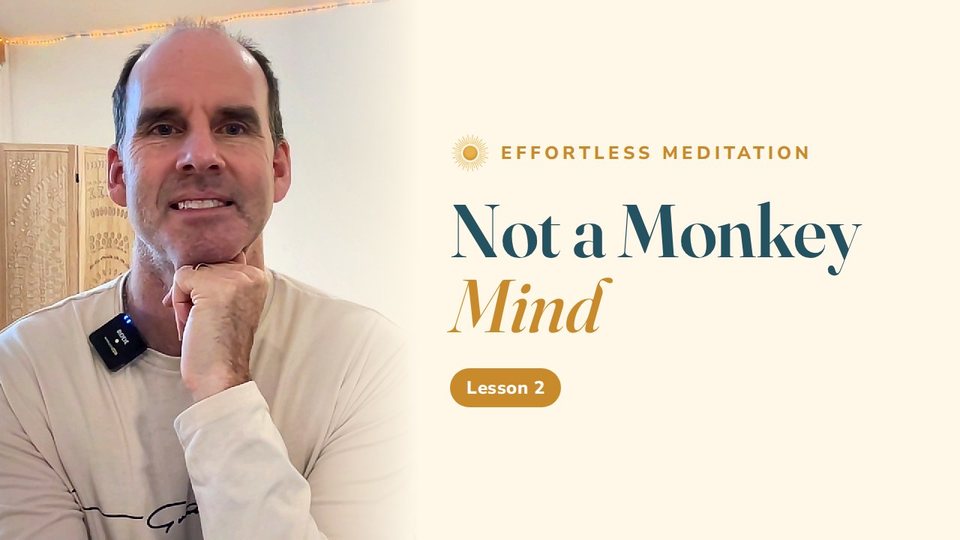
02You do not have a monkey mind. The myths that keep you stuck. 48 min
03How to practice. SSFB (Shake, Settle, Face, Belly), the golden cup, and So Hum. 59 min
04The 3 breathing practices. Box, alternate nostril, and bellows. 21 min
05A full guided meditation, from start to finish. 39 min
4 bonuses · about 24 minutes
+The Eight R's, as taught by Lorin Roche. The natural cycle a sit moves through, so a restless sit makes sense. 3 min
+The 5 koshas. A map of 5 layers of you, from the physical body to the bliss body, so you can notice a sit working even on a busy day. 4 min
+Inner smile and gratefulness. A guided practice you can do lying down, for the evenings you are too tired to sit up. 11 min
+Stand in your power. A short standing or seated practice with the receiving breath and the offering breath, for the days you cannot sit still. 5 min
Your printables
Your printables: the Practice Companion, the Myth-Busting guide and 5 reference cards
The Practice Companion. Your full workbook: the skills, the way to prepare, and a simple way to keep practicing.
The Meditation Myth-Busting guide. 10 myths, busted, and 3 effortless ways to begin. Read it alongside Lessons 1 and 2.
The SSFB card. Shake, Settle, Face, Belly: a minute to arrive in the body before you rest the mind.
The 3 breaths card. Box breath, alternate nostril, and bellows breath, with when to go gently.
The Eight R's card. As taught by Lorin Roche: the calming cycle a busy sit moves through.
The 5 koshas card. 5 layers of you, from the physical body to the bliss body.
The So Hum card. A simple, universal mantra, and what to do when the mind wanders.
All 7 are PDFs. Print them and keep them where you practice.
The skills, in plain words
What do SSFB, the golden cup, the golden thought and the Eight R's mean?
What is SSFB?
SSFB is our 1-minute way to arrive in the body before you rest the mind. It stands for Shake, Settle, Face, Belly.
Shake. Shake, bounce and wiggle, and let out a hum or a sigh.
Settle. Settle into a position that feels nourishing and supported: sitting, lying down, leaning or standing.
Face. On each exhale, soften the face, the jaw, the forehead and the cheeks.
Belly. Rest a hand on the belly and breathe low and full.
What is the golden cup?
The golden cup is a short visualization from Lesson 3. You picture a golden cup in front of you, filled with the essence and energy of a quality you cherish. You dip a finger in, take a sip, and wrap yourself in it, then carry that feeling into the sit.
What is the golden thought?
The golden thought is the moment you think, 'Wait, where was I? I'm supposed to be meditating.' It is not evidence that you were doing it wrong. It is evidence that you were doing it: you just finished a cycle, the way sleep moves down into depth and back up again.
What are the Eight R's?
The Eight R's, as taught by Lorin Roche, are a map of the calming cycle a sit moves through. A busy sit is the body doing its work, not a failure.
Relax. The body lets down its guard.
Release. Held tension begins to drain away.
Replay. The mind revisits what mattered from the day.
Repair. The system tends to what needs mending.
Restore. Energy returns to where it has run low.
Remember. What is important settles back into place.
Rehearse. The mind readies for what is ahead.
Rest. You sink into simple, deep rest.
Your teachers
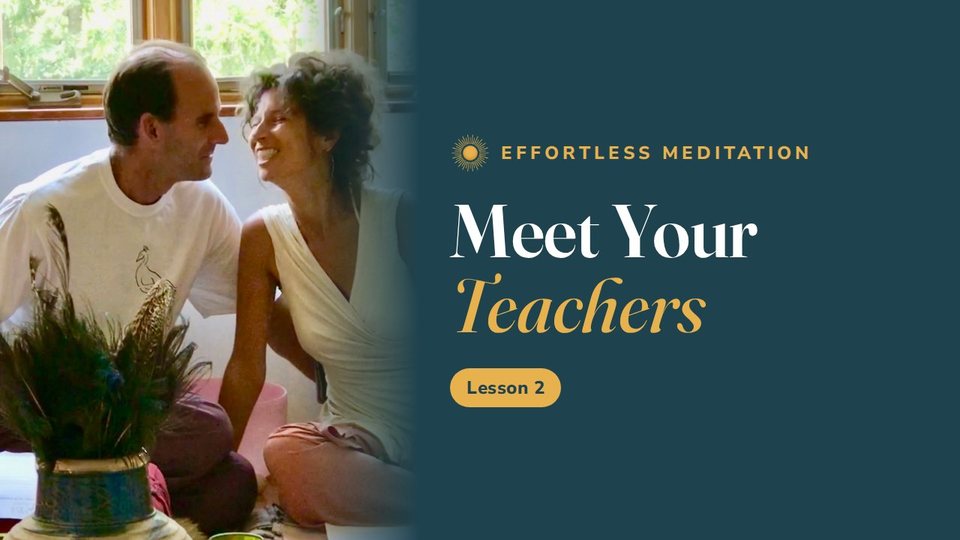
Who teaches the course? Christopher Grant and Daniela Hess
Educators and practitioners for 30 years, teaching meditation for full lives.
Christopher Grant
Co-founder of Great Energy and its lead Qigong teacher, Christopher teaches movement, breath and meditation in plain, unhurried language. He came to the practice young, out of anxiety and addiction.
Daniela Hess
Co-founder of Great Energy and a functional wellness consultant for women in midlife, Daniela co-teaches our yoga and Qigong teacher trainings, including the meditation teaching. She holds meditation as a way to greet, sort and integrate your inner world. She brings warmth, the felt body and deep care to every practice.
The course draws on many teachers, with special gratitude to Lorin Roche and the Radiance Sutras.
'The quality of the education and the knowledge of the teachers is unmatched.'Cheryl P.
What students say
What students say about learning with Christopher and Daniela
From students of our live meditation classes, and of our Qigong and teacher training programs.
I tend to just have an overactive mind, and it's very frustrating for me to meditate. But, I don't know just something about this that I was able to go deeper.
Mari, meditation class student
I came out of that so... Deeply calm and settled.
Kim, meditation class student
I felt an immediate shift towards inner peace, a calm body and softened heart.
Kat B.
You won't find more experienced, kind-hearted, ethical and professional teachers of yoga, Qigong, and meditation.
Mayya S.
Daniela's meditations are WONDERFUL journeys.
Raina E.
My experience with Great Energy has been life changing. Their online classes and workshops are well thought out, sincere and accessible for all.
Lorna R.
Enroll · lifetime access
Complete your order
$47 · 1 payment, lifetime access
Pay by card or PayPal. Secure checkout, instant access. Backed by our 7-day money-back guarantee.
Try the whole course for 7 days
Watch the lessons, try the practices, and print the cards. If within 7 days of your purchase the course is not right for you, email support@greatenergy.org with the name and email you used, and we will refund you in full.
Questions
Common questions about the course
What is included in the Effortless Meditation Course?
5 core lessons, about 3 hours 14 minutes, and 4 bonus practices, about 24 minutes. You also receive the Practice Companion and 5 reference cards as PDFs, and the Meditation Myth-Busting guide.
Who teaches the Effortless Meditation Course?
Daniela Hess and I, Christopher Grant, co-founders of Great Energy. I have practiced meditation for more than 35 years, including Sahaj Samadhi meditation with Sri Sri Ravi Shankar and silent Vipassana retreats in the tradition of S.N. Goenka. The course draws on the teaching of Lorin Roche and his Radiance Sutras.
How much time does it take each day?
A few minutes, several times a day. The 5 lessons run about 3 hours 14 minutes and the 4 bonuses about 24 minutes, and you watch them at your own pace, in pieces if you like.
Do I need any meditation experience?
No. Lesson 1 starts at the very beginning: what Effortless Meditation is, and why it is effortless. A busy mind is welcome. As I like to say, 'A wandering mind is a powerful mind.'
What if I can't stop thinking?
You do not have to stop thinking, and you do not have a monkey mind. Thoughts are part of the practice, not a sign you are doing it wrong. You learn a few small skills that let a thought come and go without a fight, and the mind settles on its own. A full mind is a mind engaged in a full life.
Is it normal to fall asleep while meditating?
Yes, and it does not mean you had a bad meditation. If you were tired, your body took the rest it needed. I often call a meditation a micro-nap for this reason. If you would rather stay alert, sit a little more upright or practice earlier in the day.
I have a lot of anxiety. Is this for me?
Then you are exactly who this is for. You are not asked to feel calm on command or to push a feeling away. You learn to welcome what is here and let your attention rest. Consider an anxious mind an invitation to pause and grow curious, not proof that you cannot do this.
Is this religious?
No. The practice draws on the Radiance Sutras and many teachers, with gratitude to Lorin Roche, and it is offered as a practical, non-dogmatic skill for a full modern life. You do not have to believe anything. You try it and notice what happens.
Is this the same as Transcendental Meditation?
No. TM is 1 specific mantra technique taught by certified TM teachers. Effortless Meditation uses a mantra as 1 doorway among several, alongside the breath and a few small skills. Read how the mantra works here.
How is this different from a meditation app?
An app plays a guided track. This course teaches the skill underneath, so you can meditate anywhere, with or without a recording. You learn why your mind behaves the way it does, a 1-minute way to arrive in the body (SSFB), and 3 doorways in: the breath, the senses and a mantra.
What is the difference between the free guide and the course?
The free guide is a short introduction with a 12-minute guided practice. The course is the full method: 5 lessons, about 3 hours 14 minutes, 4 bonus practices, 7 printables and lifetime access, for $47.
Is there research on meditation?
Yes, and we keep the claims honest: the effects measured in studies are real and modest. A 2014 meta-analysis in JAMA Internal Medicine (Goyal et al.) found that meditation programs produced small to moderate reductions in anxiety, depression and pain. The attention researcher Amishi Jha finds that a modest daily dose, about 12 minutes, helps protect attention over time. Our guidance of a few minutes, several times a day, draws on this. Meditation is not a cure or a treatment for a medical condition. Read what the research says about meditation, with links to every source.
How long do I have access to the course?
For life. It is 1 payment with no subscription, and you can watch on any device and return to the lessons whenever you like.
Is there a money-back guarantee?
Yes. Every purchase carries a 7-day money-back guarantee. If the course is not right for you, email support@greatenergy.org within 7 days of your purchase, with the name and email you used, and we will refund you in full. Our Terms of Use explain how refunds are handled.
Course details last updated .
How little can you do? How much can you allow?
Without a way in that fits your life, meditation stays on the 'should' list, and your days keep running in fifth gear.
A few minutes, several times a day, and the thoughts stop being a reason to quit. That is the whole practice, and this course shows you how: 5 lessons, 4 bonus practices, the Practice Companion, 5 reference cards and the Myth-Busting guide, yours for life for $47.
Lesson 1 is ready the moment you enroll, and you have 7 days to decide if it is right for you.

 Christopher, from Lesson 1 · 2:16