My first experience with meditation was over 35 years ago. I was very forgettable. I was nervous. I did not know what I was doing. It was in a Zen center, and I left after 15 minutes, and years went by. It was not the only room I would walk out of in those early years, the back room of a place in the East Village was another, but they all ended the same way, with me deciding this was not for me.
 A free guide and videoMeditation Mythbusting, plus a gentle guided practice. Get it free below
I tell people that on purpose, especially teachers, especially anyone who thinks the person guiding them must have always been good at this. I was not. The teacher in front of you was once the nervous beginner who left after 15 minutes and did not come back for a long time.
There was something happening in me even then, though I had no name for it and no practice to hold it. I remember being in college, 19 or 20, just beginning to explore, and there would be these moments where this normal, everyday waking consciousness would take a step back somehow. All the facts of life, the situations, and the people, and the he said, she said, and the realities that we all face, would not be so present. I used to call it winking out. It is not that the outer world was not real. It is that it was interdependent with something deep, with a raw, undifferentiated consciousness that was also there. I did not go looking for that. It arrived on its own, in the pauses. I just did not yet know that those pauses were a door.

Learning from my teachers
Eventually, I was found by my teacher, Sri Sri Ravi Shankar, who guided me into my first deep dive in silent retreats on yoga meditation, and the beautiful Sahaj Samadhi meditation that he teaches. I use the word found on purpose. It did not feel like I went out and seized it. It felt like the practice came for me when I was finally ready to stop forcing.
Years later I found the Qigong language for this. In that framework Shen is the treasure you cannot chase, and it rises on its own once the body and the energy are tended. Aiming at it directly is how people spend years going nowhere. That is my thirty-five years in a sentence, and I would have saved myself a decade if someone had put it to me that way at the start.
Along the way, I encountered and was guided by S.N. Goenka, from the Vipassana tradition, and those silent retreats were indispensable on my path to coming to this internal clarity, which is the fruit of all the practices of yoga and all the practices of Qigong. The silence did something the effort never could. It let the interior world grow quiet enough to be felt, instead of managed.
Why my practice kept changing form
I want to be honest about the shape of this path, because it is not a straight climb. My practice has changed forms many times, and I have learned to trust that. When I started practicing yoga, I was in my early 20s, and there was a story I loved about the teacher who created a vigorous style of Ashtanga called Rocket Yoga. His whole instruction came down to two words. Exercise every day. Whatever that might be. My own practice has wandered from intense yoga to Qigong, and recently my Qigong has become pick-up basketball at the YMCA. If you had told me a year ago that I would be enthusiastic about basketball at the Y, I would have thought you were crazy. And it is changing everything for me. The form matters less than the showing up.
That is the through-line of 35 years, if there is one. It was never about finding the single correct technique and gripping it forever. It was about staying in relationship with my own aliveness, and letting the doorway change as I changed. The Zen center, the silent retreats, the yoga, the Qigong, the basketball court. Different rooms, same house.
- The Zen center
- The silent retreats
- The yoga
- The Qigong
- The basketball court
What walking out after 15 minutes taught me
For a long time I carried a quiet embarrassment about that first failure, the 15 minutes, the walking out, the years that went by. Now I think it might be the most useful thing I have to offer. Because when someone tells me they tried meditation and it was not for them, I do not hear a verdict. I hear the beginning of my own story. I hear a person standing at one door, deciding the whole house is closed.
The clarity I was after all those years was not waiting at the end of enough effort. It was waiting on the other side of a gentler approach, one I would not fully meet until much later, through a teacher and a body of work I will tell you about another time. But the path to it started here, with a nervous beginner in a Zen center who was sure he had already proven he could not do this.
If you are somewhere on your own version of that path, tried it, set it down, picked up something else, wandered, doubted, I want you to know that none of that is off the path. That is the path. Exercise every day, whatever that means for you. Keep showing up to your own aliveness. The practice has a way of finding you when you stop forcing it.
Common questions
Who are Christopher Grant's meditation teachers?
His teachers include Sri Sri Ravi Shankar, who guided him into silent retreats and the Sahaj Samadhi meditation he teaches, and S.N. Goenka of the Vipassana tradition. In more recent years, Lorin Roche and the Radiance Sutras shaped what he teaches.
Does a bad first experience with meditation mean it is not for you?
No. Christopher's first attempt was over 35 years ago at a Zen center. He was nervous, left after 15 minutes, and did not return for years. A forgettable first try is not a verdict.
What is Sahaj Samadhi meditation?
A meditation taught by Sri Sri Ravi Shankar that Christopher first learned on silent retreats, part of the path that brought him to the internal clarity that is the fruit of the practices of yoga and Qigong.
Does a meditation practice have to stay the same over time?
No. Christopher's practice has changed forms many times, from intense yoga to Qigong to pick-up basketball. The form matters less than showing up to your own aliveness.
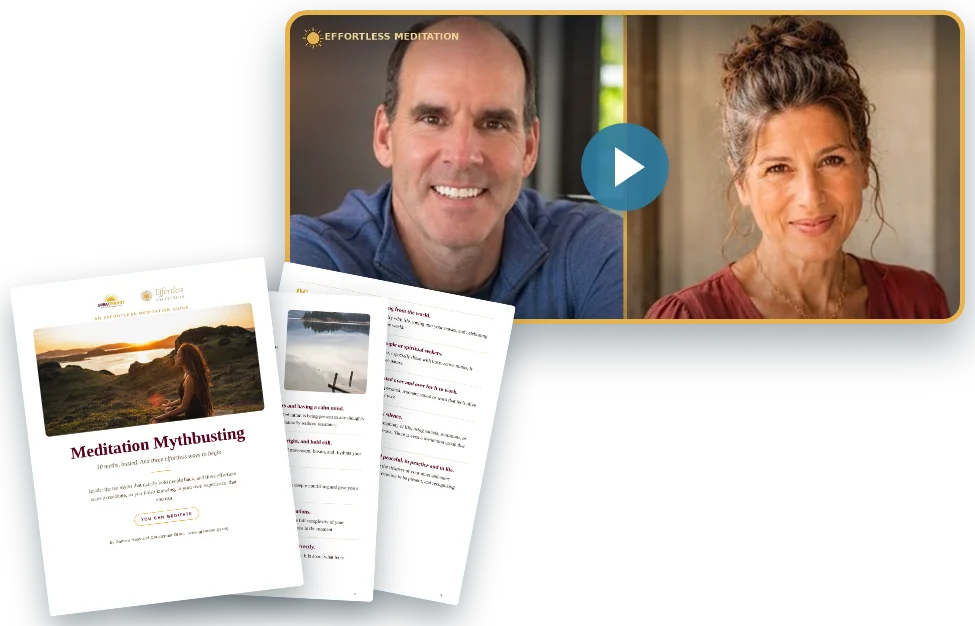
You can meditate. Start with the free guide and video.
- Meditation Mythbusting: 10 common myths, busted (PDF)
- Your First Effortless Meditation, a gentle guided practice (video)
Sources (Christopher, verbatim): Healing Our Earth panel, International Day of Yoga, June 21, 2026 (the 35-years lineage arc, Zen center, Sri Sri Ravi Shankar and Sahaj Samadhi, S.N. Goenka and Vipassana); Sunday Morning Qigong, May 17, 2026 (winking out); Office Hours, August 12, 2025 (Rocket Yoga, exercise every day, basketball at the YMCA). Assembled from his spoken lines with light connective phrasing in his voice.
More than a guided course. A living practice you carry into everyday life. See the Effortless Meditation Course, or browse the other articles.