Effortless Meditation is a gentle way of meditating where you let the mind settle on its own instead of forcing it to go quiet. You come in through the body, through the breath and the senses. You learn a few small skills. And you practice for a few minutes, several times a day, right inside a full and busy life.
 A free guide and videoMeditation Mythbusting, plus a gentle guided practice. Get it free below

Why do we call it effortless?
Effortless means Sahaj, the natural way. It is the same word as in Sahaj Samadhi, the meditation my teacher, Sri Sri Ravi Shankar, teaches, which I first learned on his silent retreats. Natural meditation. The kind your system already knows how to do.
The simplest way I know to explain it is sleep. You cannot force sleep. The harder you try to fall asleep, the more awake you lie there. What you can do is set up the conditions: lie down, dim the lights, let the day go. Then sleep comes on its own. Meditation is rest for the mind, the way sleep is rest for the body, and it works the same way. You allow it.
So I keep coming back to 2 gentle questions I often ask in class. How little can you do? How much can you allow?
- You cannot force it. The harder you try, the more awake you lie there.
- Set up the conditions: lie down, dim the lights, let the day go.
- Sleep comes on its own.
- You cannot force the mind to go quiet.
- Set up the conditions: comfortable and supported. You might rest your attention on the breath at the tip of the nose, or on a mantra.
- The mind settles on its own.
What does it feel like when you practice?
Most of the practice is small skills, and they are kind ones. Here are 2 we share early.
Imagine you are going to see a movie, and you do not know what the movie is or what it is called. You have not seen the trailer. A friend just said, you have to come see this. So you sit down in the theater, the lights come down, you sit back, and you wait for what is next without expectation. Treat the mind like that. Lean in with curiosity and watch whatever rises on the movie screen of your mind.
Or imagine you threw a dinner party, and every part of yourself is invited. They arrive in costume, the heroes and the villains, everybody. Whoever shows up at the door, you say, welcome, come on in, have a cup of tea. A busy mind, in this practice, is a room full of guests to welcome.
Underneath both skills is something I tell our students all the time. When we are feeling, we are not thinking. When we are thinking, we are not feeling. So we keep coming back to how good it feels to be breathed by the breath, and to feel the body's sensations. You might rest your attention on the breath at the tip of the nose, or on a mantra. The physicality becomes the meditation, and the settling happens on its own.
Do I have to stop my thoughts?
No. This is the prerequisite almost everyone assumes, and it is the one I most want to take away. There is no monkey mind. A full mind is a mind engaged in a full life. A wandering mind is a powerful mind.
Thoughts belong to the practice. The moment you notice you have drifted and you come back is the practice itself. Come into the body, and the mind settles on its own.
Where does Effortless Meditation come from?
From many teachers, and I want to name them, because none of this is mine alone. My path ran through a Zen center I walked out of after 15 minutes, through silent retreats with Sri Sri Ravi Shankar, and through the Vipassana tradition of S.N. Goenka. Every one of those was a real gift. I tell that story in 35 Years to a Simple Practice.
Then, in more recent years, our friend and mentor Lorin Roche. Lorin taught a style he called instinctive meditation for over 50 years. He taught that meditation is a natural human instinct, the same one that lets us rest and recover. His Radiance Sutras, a poetic interpretation of the Vijnana Bhairava Tantra and its 112 gateways into meditation, is a book that changed my life, and Daniela's, completely.
What Lorin named for me was something I had felt for years without the words for it. Meditation can be an approach to life, rather than an escape from it. So much of what people are taught asks them to deny the body, deny the restlessness, deny the fact of being a full human being. Lorin taught the opposite. The sensations, the images, the wandering, the aliveness you were told to set aside are the doorways themselves.
We learned something practical from him too. Before he ever asked a newcomer to sit for 20 minutes with a mantra, he would give them a few small skills first. A gentle taste before the deep end. That is exactly how Daniela and I teach now. It is his fingerprint on everything we do.
How is it different from what most people are taught?
Most people who think they cannot meditate have only been shown one door, the one that says empty your mind and hold still. When that door will not open, they decide the fault is theirs. I was one of those people, for years.
It is said that the Buddha taught over 80,000 doorways to meditation. Whether there are 112 or 80,000, what is commonly taught in yoga studios might be 1, or 2, or 3 of them. Effortless Meditation is one more door, a gentle one, and for a lot of people it is the one that finally opens. That is all we are claiming. More on that in The Door Was Never Locked.
How long, and how often?
A few minutes, several times a day, does more than one long, effortful session. A short pause resets the nervous system like a micro-nap, and the benefit builds over time. Many people like the edges of the day, first thing in the morning and before sleep, with small pauses in between, at a desk, or in the car before walking inside.
Comfortable and supported are the only 2 requirements. A chair with your feet on the floor, a cushion, or lying down all work, eyes open or closed. And if you fall asleep, your body took the rest it needed, and that counts.
Is Effortless Meditation religious?
No. It draws on the Radiance Sutras and on many teachers, with gratitude, and it is offered as a practical skill for a full modern life. You do not have to believe anything. You try it, and you notice what happens.
So come back to the theater. Sit down, let the lights come down, and see what shows up on the screen. You cannot force this any more than you can force sleep. How little can you do? How much can you allow?
Watch: videos on this topic

Common questions
What is Effortless Meditation?
A gentle way of meditating where you let the mind settle on its own instead of forcing it to go quiet. You come in through the breath and the senses, learn a few small skills, and practice for a few minutes, several times a day.
What does effortless mean in meditation?
Effortless means Sahaj, the natural way, the same word as in the Sahaj Samadhi meditation taught by Sri Sri Ravi Shankar. Like sleep, meditation cannot be forced. You set up the conditions and allow it.
Is Effortless Meditation the same as Lorin Roche's instinctive meditation?
No. Effortless Meditation is how Christopher Grant and Daniela Hess teach, drawn from many teachers, including Sri Sri Ravi Shankar, S.N. Goenka and Lorin Roche. Lorin's instinctive meditation and his Radiance Sutras shaped it deeply.
How often should I practice Effortless Meditation?
A few minutes, several times a day, does more than one long, effortful session. Many people practice at the edges of the day, first thing in the morning and before sleep, with short pauses in between.
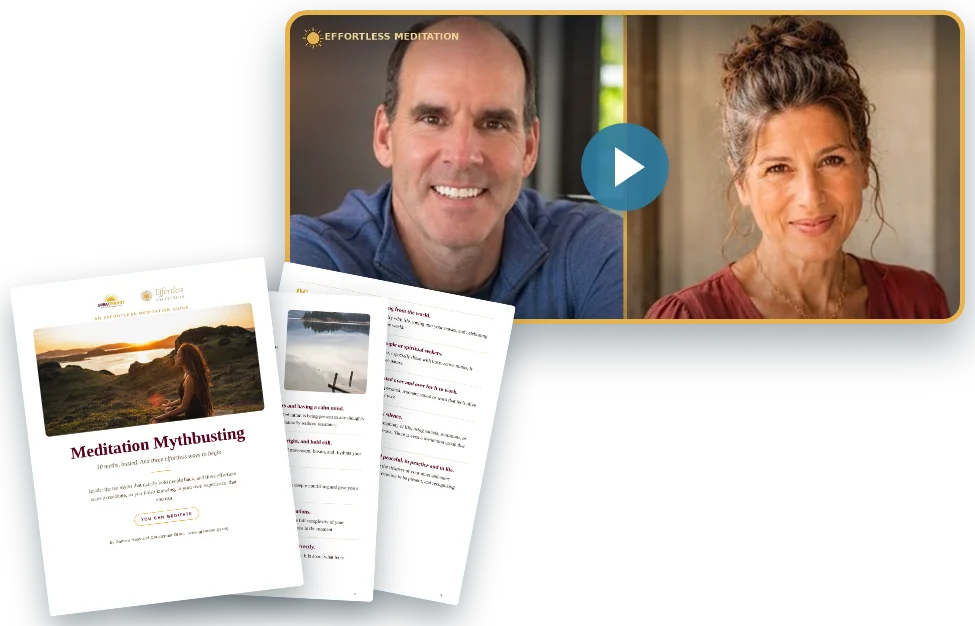
You can meditate. Start with the free guide and video.
- Meditation Mythbusting: 10 common myths, busted (PDF)
- Your First Effortless Meditation, a gentle guided practice (video)
Sources: Christopher's own teaching on this site and in class, assembled with light connective phrasing in his voice. Inspired by Lorin Roche's books Meditation Made Easy and The Radiance Sutras, and by Meditation Secrets for Women by Camille Maurine and Lorin Roche.
Ready for the full path? See the Effortless Meditation Course, or browse the other articles.