To prepare for meditation, take about 60 seconds to arrive in your body before you rest your mind. We use 4 small steps called SSFB: Shake out the body, Settle into a position that feels comfortable and supported, soften your Face on each out-breath, and breathe low into your Belly. Then you begin.
 A free guide and videoMeditation Mythbusting, plus a gentle guided practice. Get it free below

Why prepare for meditation at all?
Because meditation in a tense body is hard work, and this practice is meant to be easy. Daniela says it plainly: 'Meditation in a tense state isn't a great experience.' So before every sit, long or short, we take a minute to arrive.
Daniela teaches this part of our course, and she explains it with a trip to the grocery store. A few things are quite useful to bring: a grocery list on a Post-it, your wallet, your shoes and a shirt. 'They're not going to let you in without that.' Those are the 4 minimum requirements for grocery shopping. Have them, and in her words, 'you're prepared. It'll go how it goes.'
SSFB is the same idea for meditation. 4 really simple steps, so you show up for yourself prepared. When Daniela brought it to our live workshop, she called it 'an acronym that doesn't make any sense' and asked me to put it in the chat. When she broke it down, I told her I was mind blown.
What does SSFB stand for?
Shake, Settle, Face, Belly. Here is the whole thing, as it appears on the card we made for the course.
- Shake. Shake, bounce and wiggle, and let out a hum or a sigh, to loosen the tension you are holding.
- Settle. Settle into a position that feels nourishing and supported, sitting, lying down, leaning or standing. Forget perfect posture.
- Face. On each exhale, soften the face, the jaw, the forehead, the cheeks, and let the softness trickle down through the body.
- Belly. Rest a hand on the belly and breathe low and full, the belly rising on the breath in and falling on the breath out.
If you watch the lessons, you will hear Daniela call the second step position. That is exactly what Settle means. And she invites SSFB 'before every single little session, whether it's a micro session or a longer session.' If you have a 60-second meditation, give yourself a 60-second SSFB.
How do I shake it off?
Think of a dog. Daniela has 2 dogs, and she describes them perfectly: 'they play real hard with each other. And then when they stop, they all shake off.'
So stand up if you can, or stay seated if you prefer. For about 60 seconds, shake your body, bounce a little with your knees, and wiggle your hips. The wiggle matters, because it brings the hips in. You can brush off your arms and legs a little too, as long as you keep shaking and bouncing.
And let sound out. A hum, a sigh, any sound at all. If your body says this feels great, let it say so out loud.
Daniela is careful about what is happening here. She says it feels like releasing energy from the nervous system, and that technically the release is from the muscles. The effect is what we are after: a nervous system that feels a little more regulated as you go into meditation.
What is the best position for meditation?
Whichever position feels comfortable and supported to you, right now. Daniela calls this step 'position, not posture.'
Before you sit, ask yourself: what position would I like to be in right now? What would be nourishing or supportive? Your body may answer by lying down. Or you may sense that you want to sit up straight, and then chairs and walls make the best support, with a little pillow at the small of your back. If you love sitting cross-legged on the ground, do that.
And let go of the pictures. Daniela asks us to set aside the Instagram posts of people who look lost in bliss, and then asks the question I love most: 'Who's taking the picture?' We want to be supported and comfortable. In her words: 'That's it.'
Your best position will also change. If you spend your day in a cubicle focusing at a little screen, don't make your meditation like that. If you spend your day outdoors, you might enjoy coming in and sitting facing a wall. Daniela adds that you may love sitting upright at 5 o'clock and lying down at 10 a.m. 'There isn't a superior way of holding your body.'
Let your hands rest wherever they like, in your lap, on your thighs or by your sides, anywhere that does not ask you to hold yourself in place.
How do I soften my face?
Use the exhale. On any out-breath, invite your face to soften, whatever that means for you, without any forcing. Take 3 passes at your own pace. The first softens the face. The second finds the tiny muscles that are still subtly held. The third catches anything that held on anyway.
Then let that softness trickle down. Release your shoulders, your chest, anything held in your back and your pelvis, and let the softness move down through your legs, your calves and your feet.
Why the face? Daniela teaches that it shows us how serious we are. 'How do we know how serious we are? We can tune into our face and where we're breathing into in our bodies.' A soft face is a quick way to set seriousness down, and the belly is where we go next.
How do I breathe into my belly?
Keep your face soft, and very casually bring a hand to your belly. Your thumb can rest on the navel and your palm just below it. On the next breath in, bring the inhale all the way down to your hand. If you are lying down, the belly rises. If you are seated, it moves outward. As Daniela puts it, soften your belly, so it's like a Buddha belly.
On the breath out, the hand moves back in, or lowers. Let it be easy. A few rounds are plenty.
This is belly breathing, also called diaphragmatic breathing. It is linked to the body's rest response, which Daniela names the parasympathetic nervous system, a state of rest and relaxation. Many people find it calming. And in Daniela's words, 'that really sets us up now to go into our interior world.'
What comes after SSFB?
Your meditation, whatever it is today. Keep the breath low and easy, and let go.
In Lesson 3, Daniela moves straight from the belly into a practice of letting a memory choose you, a moment when you loved being alive. Later in the same lesson she leads a quick 30-second SSFB, and then I guide us into So Hum, which you can read about in Mantra Meditation for Beginners. SSFB also leads beautifully into breath meditation, where you simply rest your attention on the breath you already have.
If you are new to all of this, What Is Effortless Meditation? explains the approach, and our free guide is a gentle place to begin.
How short can it be?
About a minute is the whole idea, and on a busy day it can be shorter. Daniela calls it the quickie version: 30 seconds of shaking, a moment to choose a comfortable, supported position, 3 soft exhales and a few belly breaths. You will learn to do it really swiftly.
So think of the dogs, finished with their play, shaking it all off. Then think of the grocery store. Shoes, shirt, wallet, list. Shake, Settle, Face, Belly. You're prepared. It'll go how it goes.
Common questions about preparing to meditate
How long should I prepare before meditating?
About 60 seconds. SSFB takes a minute: shake out the body, settle into a comfortable and supported position, soften the face on a few exhales, and breathe into the belly. On a busy day, a 30-second version works too. The point is to arrive in the body first.
What does SSFB stand for in meditation?
SSFB stands for Shake, Settle, Face, Belly. It is the 4-step preparation Daniela Hess teaches in the Effortless Meditation Course. You do it before every sit, whether that is a 60-second pause or a longer meditation, so the body is relaxed before you rest the mind.
What is the best position for meditation?
Whatever position feels comfortable and supported to you right now. Sitting in a chair, leaning against a wall, sitting cross-legged or lying down all work. Daniela calls it 'position, not posture.' Ask yourself what would feel nourishing today, and expect the answer to change.
Why put a hand on the belly before meditation?
The hand gives the breath somewhere to go. Breathing in, you bring the breath down to your hand so the belly rises or moves outward, and breathing out, the hand moves back in. This belly breathing is linked to the body's rest response, and many people find it calming.
Can I prepare for meditation sitting down?
Yes. You can shake, bounce and wiggle while seated, or stand up if that feels good, and let a little sound out either way. If you are lying down, the belly rises on the in-breath instead of moving outward. Every step of SSFB works in any position.
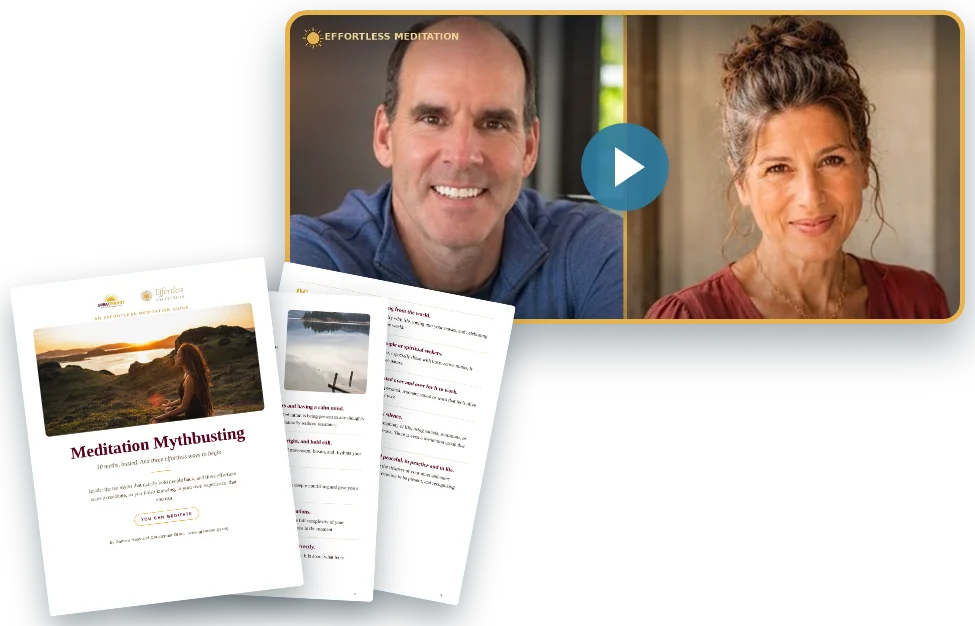
You can meditate. Start with the free guide and video.
- Meditation Mythbusting: 10 common myths, busted (PDF)
- Your First Effortless Meditation, a gentle guided practice (video)
Sources: Daniela Hess teaching SSFB in Lesson 3 of the Effortless Meditation Course (0:00 to 9:40, and the 30-second version at 41:42); Lesson 2 (Daniela on shaking it off like a dog, and Christopher and Daniela on comfortable and supported, 41:32 to 46:42), with speakers checked against the December 15, 2024 You Can Meditate workshop; and the course's SSFB card and Practice Companion.
More than a guided course. A living practice you carry into everyday life. See the Effortless Meditation Course, or browse the other articles.