A 2010 research paper sorts meditation into 3 broad types. Focused attention rests the mind on 1 chosen thing, such as the breath or a candle flame. Open monitoring watches whatever comes and goes. Automatic self-transcending uses a technique designed to settle and fall away on its own. Effortless Meditation, the way Daniela and I teach it, is its own way in.
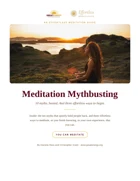 A free guide and videoMeditation Mythbusting, plus a gentle guided practice. Get it free below

How many types of meditation are there?
There are thousands of meditation styles, by any count. I have heard it said there are 80,000 different styles of meditation. Nearly every experience you have had in your life could be a gateway: the quiet at the top of a long hike, the moment a good book pulls you in, the flickering flame of a candle. I write more about those doorways in The Radiance Sutras: A Book That Changed My Life.
That is why a simple map helps. The most useful one I have found comes from Fred Travis and Jonathan Shear, in the journal Consciousness and Cognition. They took the 2 types that Antoine Lutz, Richard Davidson and their colleagues had described in 2008, focused attention and open monitoring, and added a third, automatic self-transcending. Then they sorted meditations from the Vedic, Buddhist and Chinese traditions into those 3 groups, using the brain-wave patterns reported for each practice.
What is focused attention meditation?
Focused attention means choosing 1 thing and keeping the mind on it: the breath, a word, a candle flame, an image. When the mind wanders, you notice, and you bring it back, again and again. Travis and Shear place practices such as loving-kindness and compassion meditation from Tibetan Buddhism, some Zen practice and some Qigong in this group.
For a busy mind, holding still on 1 thing can feel like hard work. In my early 20s I went to a Zen meditation at Cornell University, and I could barely sit still. More than 30 years later I still remember the rush of energy as the chaos in me came down, just a little, from 5th gear to about 4 and a half. I left and went and did something silly. I never forgot that little bit of clearing.
What is open monitoring meditation?
Open monitoring widens the view. You rest in awareness and watch whatever arises, a sound or a thought, without picking it up and without pushing it away. On Travis and Shear's map, mindfulness and Zazen sit in this group, along with some Qigong.
Some people hear 'watch your thoughts' as 'stop your thoughts', and those are 2 very different instructions. Your thoughts arise on their own and dissolve on their own. They're not the bad guy. We are not trying to get rid of them or stop them. (More on that in What Is Effortless Meditation?)
What is automatic self-transcending meditation?
This group is Travis and Shear's own addition. In their words, it 'includes techniques designed to transcend their own activity.' You use a technique, often a mantra, and the technique itself grows fainter until it falls away. Transcendental Meditation is their main example. I explain how TM differs from what we teach in Mantra Meditation for Beginners.
Here is 1 thing worth knowing as you read their map. Fred Travis directs the Center for Brain, Consciousness and Cognition at Maharishi International University, the university founded by Maharishi Mahesh Yogi, who founded TM. It makes sense, then, that TM anchors the third group. Their map builds on the earlier work of Lutz and Davidson, and it is still the clearest one I have found.
As a Qigong teacher, I love 1 detail in their paper. Practices from the Chinese tradition turn up in all 3 groups, and Qigong in at least 2. The same tradition can be practiced with a narrow focus or a wide, open one.
Keep the mind on 1 chosen thing, such as the breath, a word or a candle flame. When it wanders, come back.
Rest in awareness and watch whatever arises, without picking it up or pushing it away.
Use a technique, often a mantra, that grows fainter until it falls away.
Source: Fred Travis and Jonathan Shear, Consciousness and Cognition, 2010, building on the 2 types described by Antoine Lutz, Richard Davidson and colleagues in 2008.
How does Effortless Meditation work with attention?
With the kind of attention you already use when a good book pulls you in. Picture yourself reading a book you enjoy in a busy bus station. People are talking and walking past, and you are aware of all of it. And yet the book is your primary focus. You don't have to exert an effort to concentrate to read a book. It pulls you in.
We start with a light focus, the breath at the tip of the nose or a mantra, and we let it be interesting, the way the book is. When a sound pulls you away, you look, and you come back to the book. You don't scold yourself. The book was waiting for you all along.
Near the end of the first guided practice in our course, I say this: 'letting go even this technique. And let yourself feel and experience whatever is here right now.' In 1 sitting the focus may stay light for a while, then open wide, and sometimes the technique drops away before you notice it going.
I don't place Effortless Meditation in any of the 3 research groups. Travis and Shear sorted the practices in their paper by brain-wave patterns, and I know of no study that has recorded those patterns during our practice. I would rather tell you what it feels like than claim a label for it.
Which type of meditation is right for me?
The one you will come back to. And the answer can change. If you spend your day in a cubicle focusing at a little screen, don't make your meditation like that. Let your mind be expansive. If you spend your day out of doors in the open, you might enjoy coming in and sitting facing a wall, the way some Zen practice does.
I think of meditation as cross-training for your life. Your approach will be unique to your lifestyle and your personality, and it will shift over the chapters of your life. It can even shift within a day. You may love an indoor sit at 9 in the morning and an outdoor one at 4 in the afternoon.
Does the type of meditation change the results?
Travis and Shear argued that it does. The 3 groups differ in where attention goes and in what you actually do, and they argued that studies which average all meditation together blur those differences. That is a good reason to read any headline about what 'meditation' does with a question in mind: which meditation, practiced how? Our research page gathers the studies we draw on.
Go find your book in the bus station. Let a light focus pull you in, and let even the technique go when it is ready to go. How little can you do? How much can you allow?
Common questions about types of meditation
What are the 3 types of meditation?
In a 2010 paper, Fred Travis and Jonathan Shear sorted meditation into 3 types. Focused attention keeps the mind on 1 object, such as the breath. Open monitoring watches whatever arises. Automatic self-transcending uses a technique designed to fall away on its own, with Transcendental Meditation as the main example.
Is mindfulness focused attention or open monitoring?
Travis and Shear place mindfulness in the open monitoring group, alongside Zazen and some Qigong. In open monitoring you rest in awareness and watch whatever comes and goes, a sound or a thought, without holding on to it and without pushing it away.
Is Effortless Meditation the same as Transcendental Meditation?
No. Transcendental Meditation is 1 specific mantra technique, taught by certified TM teachers. Effortless Meditation is how Christopher Grant and Daniela Hess teach, drawn from many teachers, including Sri Sri Ravi Shankar, S.N. Goenka and Lorin Roche, with the breath, a mantra and a few small skills as gateways.
Which type of meditation is best for beginners?
The one you will come back to. Christopher Grant suggests starting with a light focus you enjoy, such as the breath at the tip of the nose, for a few minutes at a time, several times a day, and letting the practice change as your life changes.
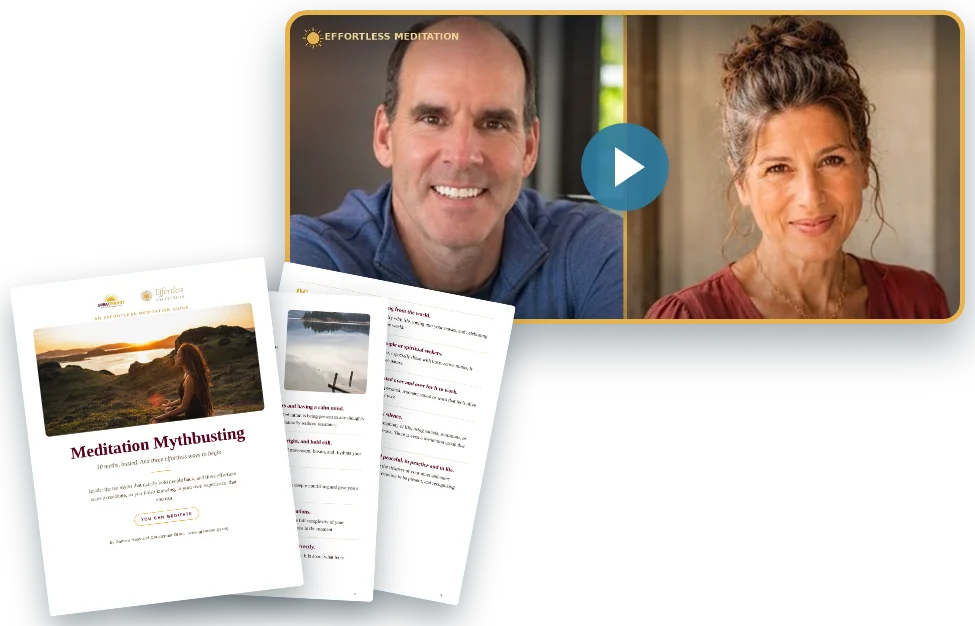
You can meditate. Start with the free guide and video.
- Meditation Mythbusting: 10 common myths, busted (PDF)
- Your First Effortless Meditation, a gentle guided practice (video)
Sources: Fred Travis and Jonathan Shear, 'Focused attention, open monitoring and automatic self-transcending: Categories to organize meditations from Vedic, Buddhist and Chinese traditions,' Consciousness and Cognition 19, no. 4 (2010): 1110-1118. Antoine Lutz, Heleen Slagter, John Dunne and Richard Davidson, 'Attention regulation and monitoring in meditation,' Trends in Cognitive Sciences 12, no. 4 (2008): 163-169. The examples in each group come from Travis and Shear's paper and the summary on the Maharishi International University research site. Christopher's own words are from the Effortless Meditation course and live workshop, lightly edited from the recordings.
Ready for the full path? See the Effortless Meditation Course, or browse the other articles.